


What is the True Cost of Fixing Problems After Injection Mold Tooling is Built?
When developing a new injection-molded product, one of the most expensive mistakes a manufacturer can make is discovering a design problem after the mold has already been built.
At that point, what might have been a relatively simple design adjustment can become a costly exercise involving tooling modifications, additional testing, production delays, and potentially compromised product performance.
At PRECISION, we believe the best time to solve manufacturing problems is before they become manufacturing problems. That’s why early collaboration, design for manufacturability (DFM), and MoldFlow analysis are important parts of helping customers move confidently from concept to production.
What Happens When Design Problems are Discovered Too Late?
Injection molds represent a significant investment. Depending on part size, complexity, material requirements, and production volumes, tooling costs can range from thousands to tens of thousands, even hundreds of thousands of dollars for very large and complex molds.
Once a mold has been manufactured, making changes isn’t always straightforward.
Consider some common problems that can emerge during initial production:
- Warping and dimensional instability: A part may not maintain its intended shape after cooling, affecting fit, assembly, or performance.
- Incomplete filling: Molten plastic may not reach every area of the mold, particularly in parts with thin walls or complex geometries.
- Sink marks and cosmetic defects: Uneven wall thicknesses can create visible imperfections or dimensional inconsistencies.
- Weld lines and structural weaknesses: Where separate flow fronts meet, the resulting weld line may affect appearance or mechanical performance.
- Extended cycle times: Poor cooling efficiency or unnecessary material thickness can increase production time and cost per part.
Discovering these issues during production trials can trigger a chain reaction of additional expenses. Tooling may need to be reworked, parts retested, and production schedules adjusted.
For companies preparing to launch a new product, these delays can have consequences far beyond the cost of modifying a mold.
How Can MoldFlow Analysis Help Prevent Expensive Mistakes?
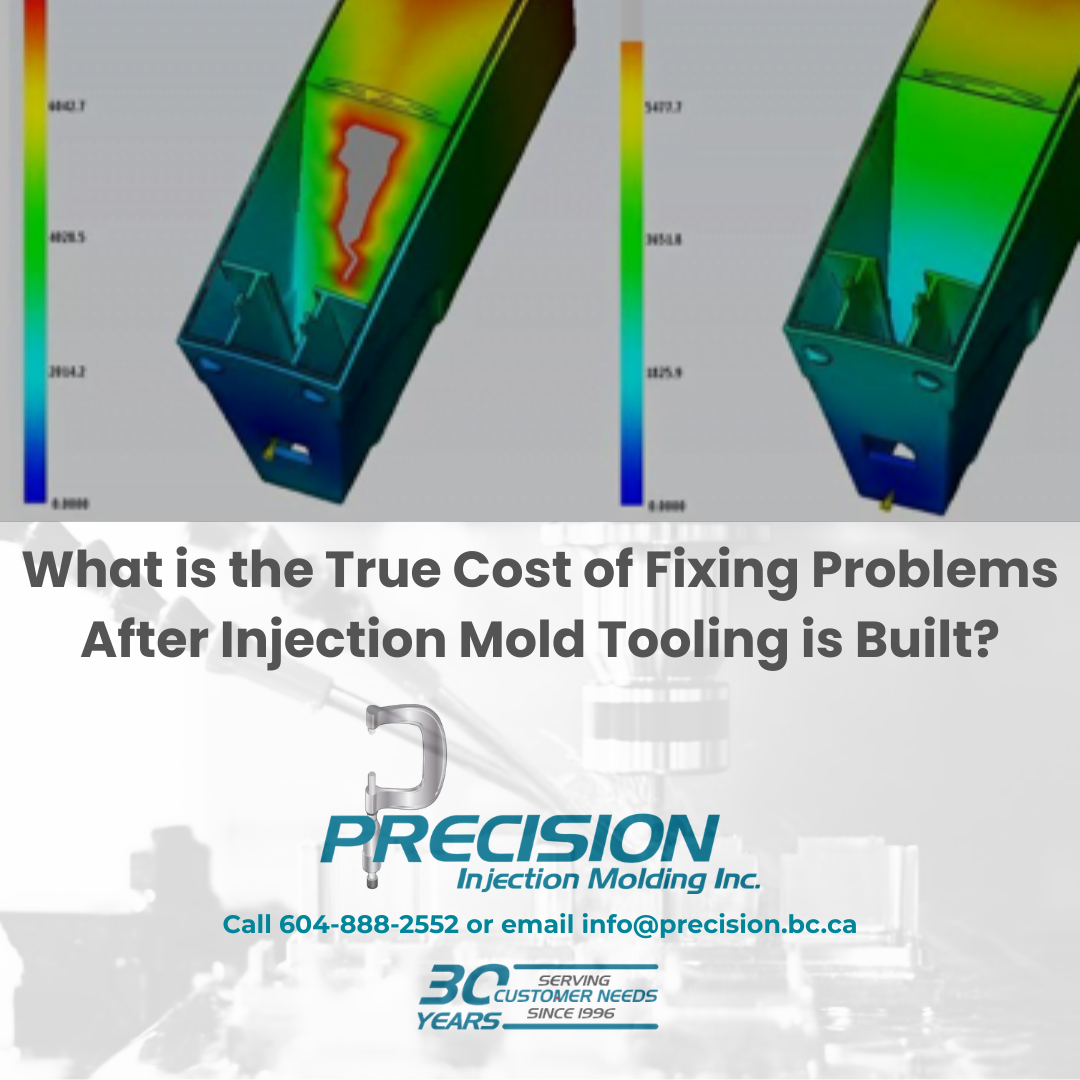
MoldFlow analysis uses specialized simulation software to predict how molten plastic will behave as it fills, packs, and cools within a mold.
Rather than relying solely on assumptions or discovering problems during physical production trials, engineers can evaluate potential manufacturing challenges while the product and tooling designs are still being developed.
MoldFlow analysis can help identify:
- Material flow challenges: Will the selected material fill the entire cavity under practical processing conditions?
- Gate placement opportunities: Where should material enter the mold to support consistent filling and minimize defects?
- Potential warpage: How might shrinkage and cooling differences affect final part dimensions?
- Weld line locations: Where will flow fronts meet, and could those locations affect part strength or appearance?
- Cooling performance: Could changes to the mold design improve cooling consistency and reduce cycle times?
The value isn’t simply in generating simulation results. It’s in using those results to make better engineering and manufacturing decisions before committing to expensive tooling.
A small adjustment during the design stage can prevent a much larger problem on the production floor.
What Do These Problems Look Like in Real-World Manufacturing?
Consider three common manufacturing scenarios that illustrate why early analysis matters.
1. A Plastic Housing that Doesn’t Fit During Assembly
A manufacturer develops a precision plastic enclosure that must fit securely around electronic components.
The initial design looks correct in CAD. However, during production trials, uneven cooling causes the housing to warp slightly, preventing proper assembly.
Without early analysis, correcting the problem could require modifying the mold, adjusting processing conditions, or redesigning sections of the housing.
MoldFlow analysis during development could help identify the potential for warpage and support changes to wall thickness, gate placement, or cooling strategies before tooling is completed.
2. A Structural Component with an Unexpected Weak Point
An injection-molded component is designed to withstand repeated mechanical loads.
During testing, engineers discover that a weld line occurs in a highly stressed area of the part, potentially compromising its performance.
Changing the location of that weld line after tooling has been manufactured may require modifications to the gating system or even more extensive tooling changes.
By simulating material flow before tooling, engineers can evaluate alternative gate locations and filling strategies to help position weld lines away from critical areas.
3. A High-Volume Part with an Unnecessarily Long Cycle Time
A customer plans to manufacture hundreds of thousands of parts annually.
The mold produces acceptable parts, but inefficient cooling and excessive material thickness result in longer-than-expected production cycles.
Even a few additional seconds per part can create significant cumulative manufacturing costs over the life of the product.
Early MoldFlow analysis, combined with thoughtful tooling and part design, can help identify opportunities to improve cooling, optimize material distribution, and reduce cycle times.
These examples demonstrate an important principle: the cost of a design problem isn’t always the cost of fixing the mold. Sometimes it’s the ongoing cost of manufacturing a part inefficiently.
Why Does Early Collaboration Make Such a Difference?
MoldFlow analysis is a powerful engineering tool, but simulation alone doesn’t guarantee a successful product.
The greatest value comes when simulation results are combined with practical manufacturing experience.
At PRECISION, we encourage customers to engage our team early in the product development process.
By reviewing part geometry, material selection, tooling requirements, production volumes, and end-use applications, our team can help identify potential risks and opportunities before they become expensive commitments.
This collaborative approach can help customers:
- Reduce unnecessary tooling modifications and rework.
- Improve part quality and dimensional consistency.
- Identify opportunities to simplify designs and lower manufacturing costs.
- Minimize production delays and unexpected engineering changes.
- Improve confidence when moving from prototype to full-scale production.
As a full-service injection molding and contract manufacturing partner, Precision looks beyond the individual molded part to consider how design decisions affect assembly, manufacturing efficiency, product quality, and long-term performance.
Are You Evaluating the Cost of Tooling or the Cost of the Entire Product?
When comparing injection molding suppliers, it’s tempting to focus primarily on the initial tooling quotation. However, the lowest tooling cost doesn’t necessarily translate into the lowest total manufacturing cost.
A mold that requires repeated adjustments, produces inconsistent parts, or operates with inefficient cycle times can quickly eliminate any initial savings.
Conversely, investing in engineering analysis and manufacturability reviews early in development can help reduce downstream expenses and improve production predictability.
The goal isn’t simply to build a mold that works. It’s to develop a manufacturing solution that delivers consistent quality, efficient production, and long-term value.
Beyond the Mold: Helping You Get It Right Before Production
At PRECISION, we understand that every product launch represents an investment of time, resources, and opportunity. Our commitment to injecting expertise into every part means helping customers make informed decisions throughout the development and manufacturing process, not simply producing parts to a drawing.
Through early engineering collaboration, design for manufacturability reviews, and MoldFlow analysis, we help customers identify potential challenges, evaluate solutions, and reduce the risk of costly surprises after tooling is built.
Before you invest in tooling, ensure you have explored what could go wrong and how to prevent it.
Learn More About PRECISION’s MoldFlow Services
Discover how MoldFlow analysis and early manufacturing collaboration can help improve your product design, reduce tooling risk, and support a more successful production launch.
Let us help you move from concept to production with greater confidence.