


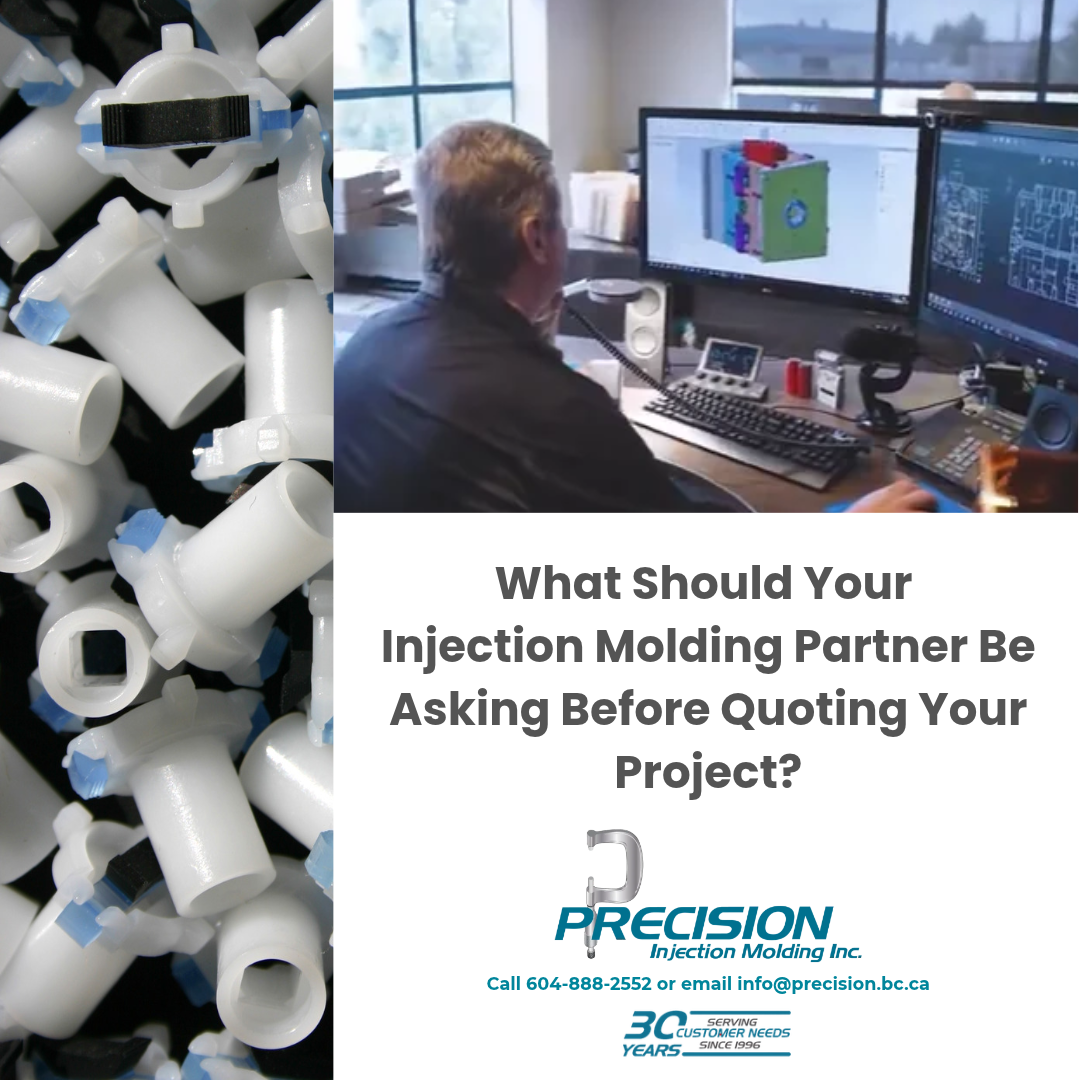
What Should Your Injection Molding Partner Be Asking Before Quoting Your Project?
We believe that great parts start with better conversations.
When OEMs, engineers and product innovators approach an injection molding manufacturer, the process often begins with submitting drawings, specifications and production requirements to request a quotation.
But does a drawing tell the entire story? While technical drawings provide essential information about dimensions, tolerances and materials, they don’t always reveal the bigger picture. How will the finished product be used? What performance challenges must it overcome? Could design modifications improve manufacturability or reduce costs?
At PRECISION, we believe the value of manufacturing expertise begins long before production. It starts with asking the right questions, understanding our customers’ objectives and identifying opportunities to improve outcomes.
Here are seven important questions your injection molding partner should be asking before quoting your next project.
1. What problem is your product designed to solve?
Understanding the purpose of a product is just as important as understanding its technical specifications. Is the component part of a medical device, marine application, industrial assembly or consumer product? What challenges will it address for the end user?
When manufacturers understand the intended application, they can provide more meaningful recommendations about design, materials and production methods.
The value: Manufacturing decisions become aligned with the product’s intended purpose rather than simply meeting the requirements on a drawing.
2. How and where will your product be used?
Operating environments can significantly influence material selection, product design and manufacturing processes.
Will the product be exposed to moisture, UV radiation, chemicals, temperature fluctuations or repeated mechanical stress? Does it require specific aesthetic qualities or resistance to wear? These considerations can affect everything from material selection to tooling design.
The value: Identifying environmental and performance requirements early helps reduce the risk of premature product failure, unnecessary redesigns and costly manufacturing changes.
3. Have your materials and manufacturing processes been validated?
A material that appears suitable during initial product development may not always deliver the desired results in production. Material selection influences strength, flexibility, durability, appearance, cycle times and overall manufacturing costs.
An experienced injection molding partner should explore whether the proposed materials are appropriate for the application and whether alternative options could improve performance or manufacturability.
At PRECISION, our experience with material selection, Design for Manufacturability (DFM) and MoldFlow analysis helps customers evaluate important decisions before committing to production tooling.
The value: Early material and process evaluation can help prevent costly changes after tooling has been manufactured.
4. Could your design be simplified to reduce manufacturing costs?
One of the greatest opportunities to improve manufacturing efficiency often exists before tooling is built.
Could part geometry be simplified? Could multiple components be combined into a single molded part? Could design adjustments reduce assembly requirements or eliminate secondary operations? These are the types of questions that can make a meaningful difference to the total cost of manufacturing.
PRECISION works collaboratively with customers to identify opportunities to improve manufacturability while maintaining the functionality and performance of the finished product.
The value: Thoughtful design improvements can reduce tooling complexity, production costs and assembly time while improving manufacturing consistency.
5. What are your anticipated production volumes and future growth expectations?
A product designed for initial market testing may have very different manufacturing requirements from one intended for high-volume production. Understanding anticipated production volumes helps determine the most appropriate tooling, materials and manufacturing strategies.
But what happens when demand increases?
A manufacturing partner should also consider how production requirements may evolve and whether the proposed approach can support future growth.
The value: Planning for scalability early can help customers avoid unnecessary tooling investments, production disruptions and costly transitions as their business grows.
6. What other manufacturing services will be required?
Injection molding may be only one part of bringing a finished product to market.
Will the product require metal components, electronics, secondary operations, assembly or specialized packaging? Coordinating these requirements across multiple suppliers can introduce additional complexity, costs and potential delays.
As a full-service contract manufacturing partner, PRECISION helps customers look beyond individual molded components to consider the complete manufacturing process.
The value: An integrated manufacturing approach can simplify supplier coordination, improve production efficiency and help customers move from individual parts to finished products with greater confidence.
7. What does success look like for your business?
Every manufacturing project has technical requirements, but successful outcomes also depend on business objectives. Is the priority reducing production costs, accelerating time to market, improving product performance or establishing a dependable long-term manufacturing relationship?
Understanding these priorities helps manufacturers recommend solutions that deliver value beyond the initial quotation.
The value: Aligning manufacturing decisions with business objectives creates opportunities for stronger collaboration, better resource allocation and long-term success.
Why Better Questions Lead to Better Manufacturing Outcomes
An injection molding quotation should represent more than the cost of producing a specified part. It should reflect an understanding of the product, its application and the manufacturing decisions that influence its success.
For OEMs, early collaboration can uncover opportunities to improve efficiency, reduce costs and strengthen supply chain reliability.
For innovators, access to experienced manufacturing professionals can help bridge the gap between a promising product concept and a commercially viable finished product.
At PRECISION, we believe the most valuable manufacturing relationships are built on collaboration, practical expertise and a willingness to challenge assumptions when a better solution may exist.
Our approach goes beyond the mold, bringing decades of experience in injection molding, product development and contract manufacturing into every customer conversation.
Injecting Expertise Into Every Part
The right manufacturing partner shouldn’t simply ask, “How many parts do you need?”
They should also ask, “What are you trying to achieve, and how can we help you get there?”
Because the right questions, asked at the right time, can make all the difference in product performance, manufacturing efficiency and long-term success.
Have a new product concept or an existing component that could benefit from a fresh perspective?
Let’s start a conversation.