When Should You Consider Insert Molding for Your Product?
What if you could eliminate assembly steps, improve product durability, and simplify manufacturing by incorporating multiple components into a single molded part?
For OEMs and product designers, reducing manufacturing complexity without compromising performance is an ongoing challenge.
Products often require metal threads, electrical contacts, bushings, or structural reinforcements that must be integrated into plastic components. Traditionally, these elements may be installed after molding, adding labour, handling, and potential points of failure.
But what if those components could be integrated directly into the molding process?
Insert molding offers an opportunity to simplify production, improve functionality, and potentially reduce total manufacturing costs.
What is Insert Molding?
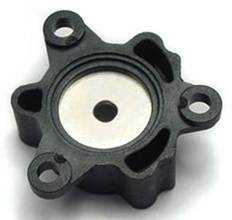
Insert molding is an injection molding process in which a premanufactured component, typically metal, is positioned inside a mold before plastic is injected around it.
As the plastic cools, the insert becomes integrated into the finished component.
Common applications include threaded metal inserts, electrical contacts, bushings, mounting points, and structural reinforcements.
By combining materials and functions within a single molded part, manufacturers can potentially eliminate secondary assembly operations.
When Does Insert Molding Make Sense?
Insert molding can offer advantages when a product requires:
- Reduced assembly: Integrating components during molding can eliminate secondary insertion operations, reducing handling and labour.
- Improved durability: Metal inserts can reinforce fastening points and provide greater resistance to repeated assembly, torque, or mechanical stress.
- Greater manufacturing consistency: Properly designed tooling can help maintain precise insert positioning and reduce variation associated with secondary assembly.
- Simplified production: Combining multiple components into one molded part can reduce manufacturing steps and streamline downstream operations.
- Lower total manufacturing costs: Although tooling and molding may be more complex, savings in assembly, handling, and inspection can improve overall production economics.
However, insert molding isn’t always the best solution. For some applications, installing inserts after molding may offer greater flexibility or lower costs, particularly at lower production volumes.
The key is evaluating the complete manufacturing process rather than the cost of an individual part.
What Should You Consider Before Committing to Tooling?
Successful insert molding begins with good product design. Before committing to tooling, OEMs and engineers should consider several important questions:
- How will the insert affect product performance?
Insert geometry, material compatibility, and surrounding wall thickness can influence strength, dimensional stability, and long-term reliability. - Can the insert be positioned consistently during molding?
Tooling must securely hold the insert during injection to prevent movement, misalignment, or defects. - What are the anticipated production volumes?
Higher volumes may justify specialized tooling or automated insert placement, while lower volumes may favour secondary assembly. - Will insert molding reduce total manufacturing costs?
The evaluation should consider tooling, cycle times, insert handling, secondary operations, and quality requirements.
Addressing these questions early can help identify opportunities to improve manufacturability and avoid costly changes after tooling is built.
Could Insert Molding Improve Your Next Product?
The best manufacturing decisions begin with understanding how a product will be used, how it must perform, and how it can be produced efficiently.
At PRECISION, we work with OEMs and product designers to evaluate material selection, part geometry, tooling requirements, and manufacturing processes before production begins.
Our experience in injection molding, design for manufacturability, and contract manufacturing helps customers explore opportunities to simplify production, improve product performance, and manage costs.
Could integrating components directly into your molded part eliminate unnecessary manufacturing steps?
It’s a question worth exploring before finalizing your next product design.
Talk to our Experts to discuss your product requirements and manufacturing options.
Injecting Expertise Into Every Part